

Huraima Ghaffar
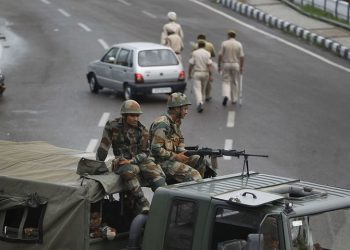
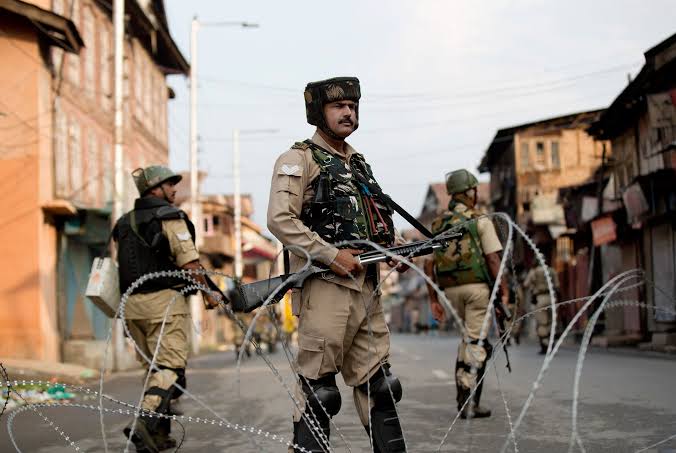
3 a.m. knocks. Broken doors.2800 detained in 3 weeks. This is what ‘Post-2019 Normalcy’ looks like in IIOK. In the years since 2019, that unsettling sounds of sirens spreading chaos has replaced school bells and market chatter across IIOK. The system which was tagged as an action towards Unity quietly became a system of laws that reached homes, streets and daily life. This paper asks what happened to rights when “special status” was replaced with “special powers”.
Why India has done this Abrogation of Article 370 and 35-A which snatched rights from Kashmiri people? Firstly to start with we need to understand the stance of India which it showed in front of the world. Apparently, India has been doing all these abrogation for eradicating terrorism, bringing the whole region under one constitutional authority i.e. Indian Government. But if we look into the reality of this, so we can see the extreme human rights violations that were prevailing right before this Nullification of Jammu and Kashmir Status in 2019.A Senior Research Analyst explained this situation by arguing that this Abrogation of 2019 is not a constitutional change but it is a far more reaching political and humanitarian event which exploited and crippled Kashmiris. We have seen restrictions on movement and assembly, mass detentions of political leaders and youth, extended lockdowns, communication blackouts which manifests the Indian brutal ‘Social Strangulation’ upon Kashmiris. Statistics also reveal this very fact. There is a book titled Surveillance, Counter Insurgency and Politics of Fear which quoted the India’s impunity in Kashmir with respect to the violations mentioned before. For Instance Kashmir bleeded again under Modi’s rule. Since Amalgam on April 2025, boys like Imia Ahmed Magray were picked up, tortured, killed and dumped in drains, then called terrorists. From Altar Lalli in Bandipora to Ghulam Rasool in Kupwara, the killings have not stopped. Seige and search operations were normal before the April 22.Pahalgam Attack incident, from Feb to April 2025; at least 28 big search operations hit 13 districts. After April 22, it got worse. Over 2,800 youth were picked up and more than 65 homes in Srinagar alone were raided in 3 weeks. Villages in Pulwama, Shopian, Kulgam and Kupwara were locked down; belongings destroyed, and cash, jewelry and papers taken. Hence, we come to this conclusion that India is doing all this humanitarian violation in Jammu and Kashmir because it has a hidden motive of acquiring power in the region. According to a theory called ‘Constructivism’ which states that a state actions are a composite of national identity, ideology, social norms, and shared ideology. As India’s ruling apparatus is driven by nationalist ideologies which push for a unified and centralized concept of nation and that’s why India wants to rule as a whole in the region by making Jammu and Kashmir territory a part within their area of influence. This is supposed to be the deep rooted conspiracy of India under the shadow of their apparent approach towards the abrogation of 2019.
Secondly, AFSPA’s role always proved that it holds a license to kill, terrorize and disappear people by using its legal immunity and extraordinary power given by Indian Parliament. The human rights happenings after 2019 till 2026 shows the inefficient role of AFSPA as elements of human rights violations were seen massively. A total of 1,030 extra judicial killings were done in the region according to the recent statistics given by KIIR. Why is it prevailing? Well according to the facts and figures which don’t seem quite apparent in eyes of layman tells us that according to the Section 3 of the AFSPA, it allows the government to classify regions as ‘Disturbed regions’ and authorize the use of special military forces but this section does not define clear jurisdiction of applying areas and hence is really vague in terms of its rules and execution. When the manifesto is weak and the departments are not directed towards achieving clear objectives, uncertainty and chaos prevails which provides a way for injustice to the people on whom that very law is applying. That’s why the region coming under AFSPA primarily Arunachal Pardesh, Assam, Nagaland, Jammu and Kashmir is facing brutal realities of human exploitation in the name of creating peace and stabilization in the region primarily after the Abrogation since this department was established in 1958 but escalation prevailed primarily after 2019 Abrogation and more after Pahalgam Attack on 22nd April,2025.Same is the case with UAPA, apparently it was established on the name of counter terrorism effort but it resulted in huge mass oppression. This law was targeting social media influencers, journalists, and civilians as they were raising slogans against the Indian Government policies in the territory. Here it actually represents the intentions of India that they were not transparent, the establishment of legal frameworks like AFSPA and UAPA are just the pawns set by India to exercise its power and control in the region along with a legal slogan of ensuring peace apparently.
India is actually doing democracy on paper vs governance by coercion. What it means? It means that India claimed to bring stability and equal rights in the region of Jammu and Kashmir when India abrogated the Article 370 and 35-A in 2019 but later on we have seen that detentions, civilian exploitations, security minimization prevailed in the region even more after abrogation. So, the question is why it didn’t bring revolution in the region in terms of equality and peace even after making laws within the region like (UAPA) and (AFSPA)?Because India never took these steps for transparency or integration of the people of Jammu and Kashmir, it took these steps only for integration of their own territory. This situation literally manifests A Library with Open Shelves. Meaning by information was reported in concerned departments but was never preceded further for execution.
To conclude, we can say that after diving deep into the pool of hidden conspiracy played by India behind this abrogation, that all the apparent and shallow actions that seem right are not actually right. We need to reconsider every angle of an issue to devise a solution for it respectively. India apparently played so smartly by abrogating the Article 370 and 35-A by stating their hypocratic argument of ensuring peace and economic stability in the region of IIOK but as the implications appeared in terms of grave human rights violations proved India’s hidden motives clearly.

About the Author: Huraima Ghaffar is a research intern at YFK and the author of this article.