

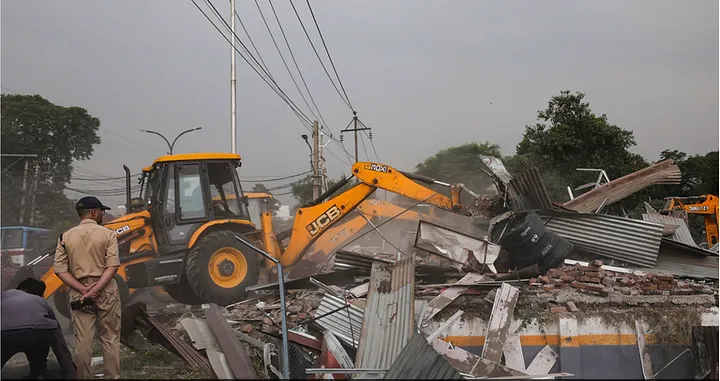
A bulldozer is not a court. But when homes and places of worship are demolished soon after protests, communal clashes or accusations of crime, the distinction can begin to feel academic to the people watching their lives reduced to rubble.
The issue is not whether every demolition in India is unlawful, or whether every municipal action is religiously motivated. Governments have a duty to enforce building and land laws. The issue is whether that duty is being carried out through fair, transparent procedures—or whether demolition has become a form of punishment, imposed before responsibility is established in court.
The dispute over the Pir Ahmed Shah Dargah in Gujarat’s Gir Somnath district brings that question into sharp focus. Eight Muslim residents have challenged its demolition in the Gujarat High Court. Petitioners say the shrine, which they describe as centuries old, was razed in the early hours of August 19, 2026, along with a historic Persian inscription. They allege that the transfer of the waqf property was approved without the proper consent of trustees and in breach of laws governing waqf land and protected monuments. The state’s account and the petitioners’ claims must be tested in court. But their questions are plainly serious: who authorised the transfer, what protections applied, and why was the structure demolished before those questions were resolved?
This is not the first such dispute in Gir Somnath. In September 2024, a large police deployment accompanied bulldozers and excavators into Prabhas Patan. The district administration described the operation as an anti-encroachment drive on government land. Residents contested that account. Nine Islamic religious structures and 47 mostly Muslim-owned homes were demolished, affecting families and devotees. Local residents have also pointed to older revenue records concerning some shrines. Such claims do not by themselves settle questions of ownership. They do make transparent disclosure of land records, notices and orders essential.
The concern reaches beyond one district. In February 2024, Gujarat’s then minister of state for home affairs told the state assembly that 108 Islamic shrines had been demolished across Gujarat. Government leaders have defended coastal demolition campaigns as necessary to remove illegal structures and protect public welfare. Those explanations deserve scrutiny, not automatic dismissal. But when religious sites and Muslim homes are repeatedly among the targets, the state must show, with records and consistent procedures, that the law is being applied evenly.
The evidence of a wider problem is troubling, though it must be described with care. Amnesty International’s 2024 report examined cases in five states and Delhi, documenting 128 properties belonging to Muslims demolished between April and June 2022 and at least 617 people made homeless. It was a case study, not a nationwide count, and it does not establish that every demolition was religiously motivated. It does show the human cost when people lose homes without meaningful notice or a fair chance to challenge the action.
India still lacks a reliable, publicly available national register of demolitions recording the legal grounds, notice given, owners affected, appeals and outcomes. Without such information, the government cannot convincingly demonstrate even-handed enforcement, and the public cannot measure whether some communities bear a disproportionate burden. Transparency is not a concession to critics. It is a basic condition of lawful administration.
Demolitions also sit within a broader climate of religious tension. India Hate Lab recorded 668 in-person hate-speech events targeting religious minorities in 2023, primarily Muslims and Christians. This is the organisation’s monitored count, not an official census of all such events. Its significance lies partly in the question it raises: are prominent speakers held accountable, and do police respond consistently to threats, regardless of who makes them?
The law, too, has become a source of anxiety. The Citizenship Amendment Act offers a route to citizenship for specified non-Muslim migrants from Afghanistan, Bangladesh and Pakistan who arrived before the end of 2014; it does not, by itself, strip Indian Muslims of citizenship. Yet its explicit religious distinction, alongside political debate about a nationwide citizenship register, has intensified fears of unequal treatment. State anti-conversion laws raise separate concerns where broad definitions and uneven enforcement may expose religious activity or interfaith relationships to police action. These laws differ by state, making careful, case-by-case scrutiny all the more important.
A South Asia Justice Campaign tracker adds further concerns, while its figures should be understood as monitoring data rather than official totals. It reported at least 27 Muslim deaths in 2026, the highest annual toll in its tracking period since 2022. For August to October, it documented deaths involving both state authorities and non-state groups, including cow vigilantes. The tracker also reported extensive police shootings of Muslim men in Uttar Pradesh in cases linked to alleged cattle activity. State police figures cited in the report showed Muslims accounted for 110 of 316 people killed in police encounters since 2017, despite constituting about 19 per cent of the state’s population. These numbers warrant independent examination and accountability, not political point-scoring.
The tracker also raised questions about electoral-roll revisions. Millions of names were removed from draft lists in a nationwide exercise, while researchers examining Maharashtra estimated that Muslim voters made up a greater share of deletions than their estimated share of the electorate. A deletion is not proof of discriminatory intent; voter rolls require maintenance. But large-scale exclusions, slow appeals and bulk objections demand safeguards strong enough to ensure that eligible citizens are not shut out of the ballot.
India’s institutions have not ceased to function. In November 2024, the Supreme Court issued nationwide demolition guidelines requiring advance notice and an opportunity to challenge an order. It also said property should not be demolished merely because someone is accused or convicted of a crime. That principle is fundamental: punishment belongs to the courts, not to executive officials operating heavy machinery. The test now is whether the guidelines are followed and whether people can obtain remedies before their homes are destroyed.
The answer should begin with facts: publish demolition orders and notices; disclose land and heritage records; investigate violence impartially; prosecute incitement consistently; and restore or compensate people where officials acted unlawfully. Courts must be accessible before the bulldozer arrives, not only after the rubble is cleared.
A bulldozer can remove a structure. It cannot establish guilt, protect equal citizenship or repair communal trust. When the machinery of government begins to look like a verdict delivered in advance, the rule of law is at risk for everyone.
About the Author:
Altaf Hussain Wani is the Chairman of the Kashmir Institute of International Relations (KIIR), specializing in the analysis of Kashmir politics, policy, and international advocacy. He can be reached on X at @sultan1913 or via email at; saleeemwani@hotmail.com.