

Pakistan has urged the international community to “act with urgency” to stop Israel’s “reckless” campaign in Lebanon and advance a diplomatic solution to the escalating conflict when the UN Security Council met in emergency following Israeli forces’ deepest incursion into the Arab country.
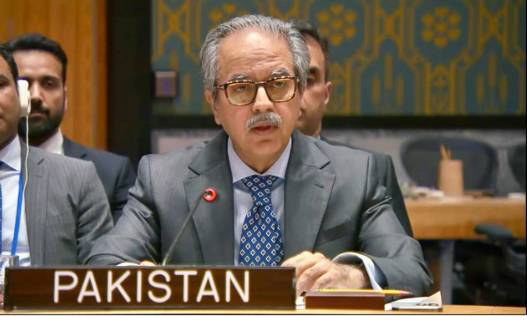
“Sustainable peace can only be achieved through dialogue and diplomacy,” Ambassador Asim Iftikhar Ahmad, permanent representative of Pakistan to the UN, told the 15-member Security Council on Monday night.
“We also welcome the efforts of the United States in facilitating the ceasefire between Lebanon and Israel, and we support their continuing engagement in this process,” he added.
The Council meeting was convened by France after Israel pushed farther into Lebanon, including Beaufort Castle, while Hezbullah expanded rocket, drone and missile attacks into Israel.
Despite the ceasefire arrangement and direct talks between Israel and Lebanon, the Pakistani envoy said, the security and humanitarian situation in Lebanon continues to deteriorate drastically, with an expansion of Israeli military operations and ground incursions into Lebanese territory, pointing out that 2,000 square kilometers, nearly 20% of Lebanon, now lies under illegal Israeli occupation, inflicting immense suffering on civilians.
“It seems it is the same strategy, the same playbook that we have seen elsewhere: indiscriminate killing, forced displacement, and occupation,” Ambassador Asim Ahmad told delegates.
Since March this year, more than 3,400 people, including women and children, have been killed and over 10,000 injured, with More than one million displaced. Equally alarming, the Pakistani envoy added were the Israeli attacks on humanitarian and medical personnel, killing 125 health workers and injuring over 300 since March.
Pakistan, he said, appreciates Lebanon’s efforts to restore stability, strengthen state authority, and ensure that the use of force remains the exclusive prerogative of the Lebanese state through its legitimate institutions, with the Lebanese Armed Forces playing a central role.
In this regard, he said Pakistan calls for full respect for Lebanon’s sovereignty and territorial integrity; Immediate cessation of hostilities and strict adherence to the ceasefire by all sides; implementation of Resolution 1701, with complete Israeli withdrawal to the Blue Line, which separates Lebanon with Israel.
“Pakistan stands in solidarity with the people and Government of Lebanon and will continue to support all efforts aimed at promoting peace, stability, and hope in the region,” Ambassador Asim Ahmad said in conclusion.
Opening the debate, Martha Ama Akyaa Pobee, the Assistant Secretary-General, Departments of Political and Peacebuilding Affairs and Peace Operations, reported that the situation in Lebanon is deeply alarming,” citing “Israeli ground troops pushing further north into Lebanese territory” and “intensified Hezbullah attacks reaching deeper into Israel”.
She said recent Israeli incursions included the capture of Beaufort Castle, advances north of the Litani River in the “Yohmor triangle”, intensified air strikes across southern Lebanon, the Beqaa Valley and the outskirts of Beirut, and sweeping “urgent warnings” for civilians to evacuate areas south of the Zahrani River.
Ms Pobee also cited extensive military activity reported by the United Nations Interim Force in Lebanon (UNIFIL) north of the Blue Line, including 992 Israel Defence Forces projectile trajectories recorded on 30 May — the highest number since the 17 April cessation of hostilities.
Hizbullah has continued to launch dozens of rockets, anti-tank guided missiles, and drones – including increasingly deadly fiber-optic drones, Ms Pobee said. It has also used surface-to-air missiles and improvised explosive devices against Israeli troops and assets inside Lebanese territory, while escalating strikes deeper into Israel in recent days.
“These developments mark a dangerous and alarming escalation,” she said, as they directly undermine the cessation of hostilities understanding announced by the United States on 16 April and eroding fragile diplomatic efforts to de-escalate the situation.
Jerome Bonnafont, the Ambassador of France, who sought Monday’s meeting, said “nothing can justify the continuation and scale of (Israeli) military operations in Lebanon” – thousands of civilian deaths and injuries, and the forced displacement of populations, or its ever-deeper occupation of Lebanese territory.
“This constitutes a major strategic mistake on Israel’s part,” he said.
Furthermore, the French envoy added, these operations are contrary to the commitments Israel undertook on 17 April, and to the resolutions of this Council. It is urgent that the guns fall silent.
This headlong rush took a symbolic dimension on Sunday by planting its flag on the Beaufort fortress, which served as a base during its occupation of southern Lebanon until 2000.
“Israel is returning to a period that many believed was behind us,” Ambassador Bonnafont warned, stressing: “History is instructive. The same causes are highly likely to produce the same effects.”