


Muhammad Waleed Akhtar
There is a particular kind of brutality that wears the costume of law. It does not arrive as chaos. It arrives with paperwork, uniformed officials, and the mechanical groan of heavy machinery. It files demolished homes under “anti-encroachment drives.” It catalogues detention without trial as “preventive custody.” It records torture as “enhanced interrogation.” In Indian illegally Occupied Jammu and Kashmir (IIoJK), this bureaucratic violence has a name that even its practitioners can no longer disguise: collective punishment. And it is being visited, with method and deliberateness, upon a civilian population whose only proven crime is living in a territory that New Delhi has chosen to govern not through consent, but through consequence.
The facts are not in dispute. They are documented by the United Nations, corroborated by international human rights organizations, and in several instances confirmed by India’s own Supreme Court. What New Delhi disputes is not the facts. It is their relevance.
In the weeks following the Pahalgam attack of April 2025, homes belonging to families of alleged militants were reduced to rubble across IIOJK. Not by court order. Not after due process. Not following any judicial determination of guilt. By administrative instruction, executed under military supervision, by bulldozers that recognize no right of appeal.
United Nations human rights experts were unambiguous. These demolitions, they stated formally, “constitute collective punishment,” prohibited under international humanitarian law since the Geneva Conventions of 1949. The families whose homes were destroyed had not been charged, tried or convicted of anything. They were punished for the alleged actions of a son, a husband, a brother. That is not a security measure. That is inherited guilt administered by the state.
This also violates India’s own domestic jurisprudence. In November 2024, the Supreme Court of India ruled explicitly that authorities cannot demolish property belonging to individuals accused of crimes without due legal process. In IIOJK, the demolitions continued regardless. India’s highest judicial authority spoke. The machinery of the state did not pause. This is not a gap between law and implementation. It is a conscious decision that legal protections apply everywhere in the republic except where they are needed most.
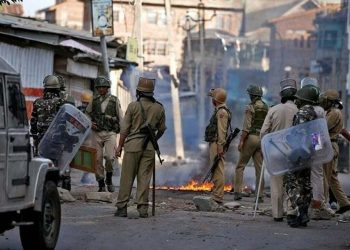
Mass detention was the other instrument. UN human rights experts documented approximately 2,800 arrests across IIoJK in the aftermath of the Pahalgam attack. Among those detained were journalists, civil society activists and ordinary citizens with no established connection to violence. They were not arrested on evidence. They were arrested on suspicion, on proximity, on the misfortune of being Kashmiri at the wrong moment.
The Public Safety Act permits detention for up to two years without charge or trial. The Unlawful Activities Prevention Act enables indefinite detention, makes bail a near impossibility, and places the burden of proving innocence upon the accused rather than the state. These are not emergency measures reluctantly invoked in crisis. They are standing statutes used routinely to punish dissent and enforce silence. Many detainees were held incommunicado, denied lawyers, denied family contact. Credible reports of torture reached the UN. India did not investigate. When impunity is structural, atrocity becomes routine.
India’s defense follows a familiar script: Kashmir faces a genuine militant threat and extraordinary circumstances demand extraordinary responses. This argument has been made, in nearly identical language, by every state that has ever imposed collective punishment upon a civilian population. It was the argument in Algeria. In Northern Ireland. In Palestine. History found against the occupying power in each case.
Test it against its own logic. If mass detention and punitive demolitions were effective counter-insurgency tools, Kashmir would have been stabilized long ago. India has employed them since the early 1990s. Three decades later, the militancy persists, grievances remain unaddressed, and the population has not been reconciled to Indian rule. Collective punishment does not pacify a population. It produces the next generation of resistance.
The international community’s response has been, without diplomatic softening, a failure of collective responsibility. The UN recommendations are neither radical nor politically loaded: end arbitrary detentions, halt punitive demolitions, investigate torture allegations. They do not ask India to resolve Kashmir’s final status. They ask only that India extend to Kashmiri civilians the minimum protections it guarantees every other citizen of the republic. India has declined even this, and a world attentive to India’s economic and strategic weight has largely allowed it to do so.
A state that governs this way is not fighting extremism. It is manufacturing the conditions in which extremism becomes, for some, the only remaining language.
The bulldozer does not build order. It builds the memory of disorder, and memories of that kind do not fade. They organize.
The author is a student of International Relations at the International Islamic University, Islamabad. Currently, he is serving as an intern at the Kashmir Institute of International Relations Islamabad.