

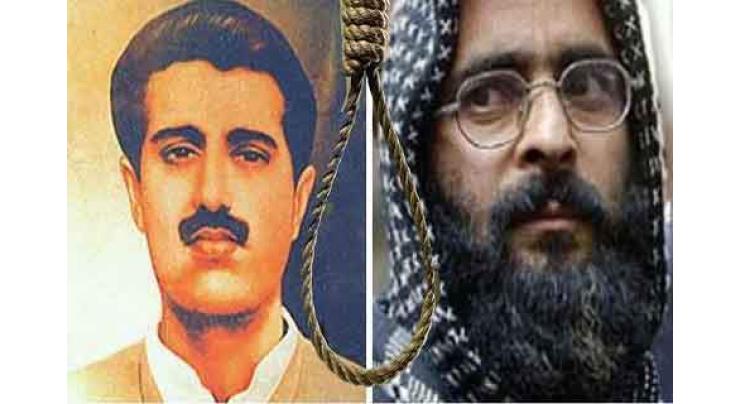
February brings a particular heaviness to those who chronicle the human cost of the Kashmir conflict. Sandwiched between the Nineth and eleventh days of this month lie the anniversaries of two judicial killings that continue to haunt the conscience of anyone who believes that justice should be blind rather than politically convenient. In the penal archives of New Delhi’s Tihar Jail, two unmarked graves hold the remains of Maqbool Ahmed Butt and Muhammad Afzal Guru—Kashmiri men executed by the Indian state three decades apart, united in death by the denial of dignity both in life and after the noose tightened around their necks.
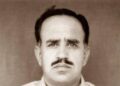
To write about Maqbool Butt is to write about the architecture of resistance itself. Here was a man who did not merely whisper about freedom in the safety of drawing rooms but crossed the Line of Control twice—an act of physical and political courage that demonstrated the geographical unity of a divided people. The founder on going struggle Maqbool Ahmed Butt represented a generation that believed the struggle for selfdetermination required more than diplomatic petitions; it demanded preparation, organization, and the willingness to bear the ultimate cost.
When the Indian judiciary convicted him in a murder case riddled with witness retractions and procedural irregularities, and the hangman pulled the lever on February 11, 1984, the state harbored a specific delusion: that this execution would serve as a terminal warning to Kashmiris not to think of freedom from Indian occupation. The gallows, they believed, would function as a period at the end of a sentence, a full stop on the conversation about self-determination. Instead, the soil of Kashmir absorbed Butt’s blood and sprouted an entire generation of volunteers. The message intended to induce fear became a beacon of sacrifice. Hundreds of thousands of young Kashmiris, witnessing how the state treated their brightest son, crossed the threshold from sympathy to commitment, choosing the path of resistance over the safety of submission. The occupation’s attempt to decapitate the movement instead multiplied its soldiers.
Three decades later, on February 13, 2013, the state machinery returned to the same gallows to repeat its grim ritual, this time targeting one of those very volunteers who had heeded Butt’s unwitting call. Muhammad Afzal Guru was not merely an innocent man trapped in a web of conspiracy; he was the organic product of a resistance culture that Butt’s martyrdom had fertilized. His journey from a medical student to a committed freedom fighter mirrored the trajectory of thousands of Kashmiris who realized that the Indian state would not yield an inch of justice without resistance.
Yet Guru’s case represents something even more sinister than judicial overreach—it stands as a meticulously state-managed theater of scapegoating. Convicted for his alleged role in the 2001 Parliament attack—a crime he consistently maintained he did not orchestrate—Guru was the perfect offering for a vengeful state seeking catharsis. His trial was marked by legal representation that can only be described as farcical, confessions extracted under circumstances that violated every norm of due process, and a Supreme Court judgment that admitted the evidence was circumstantial yet justified the death penalty to “satisfy the collective conscience of the society.”
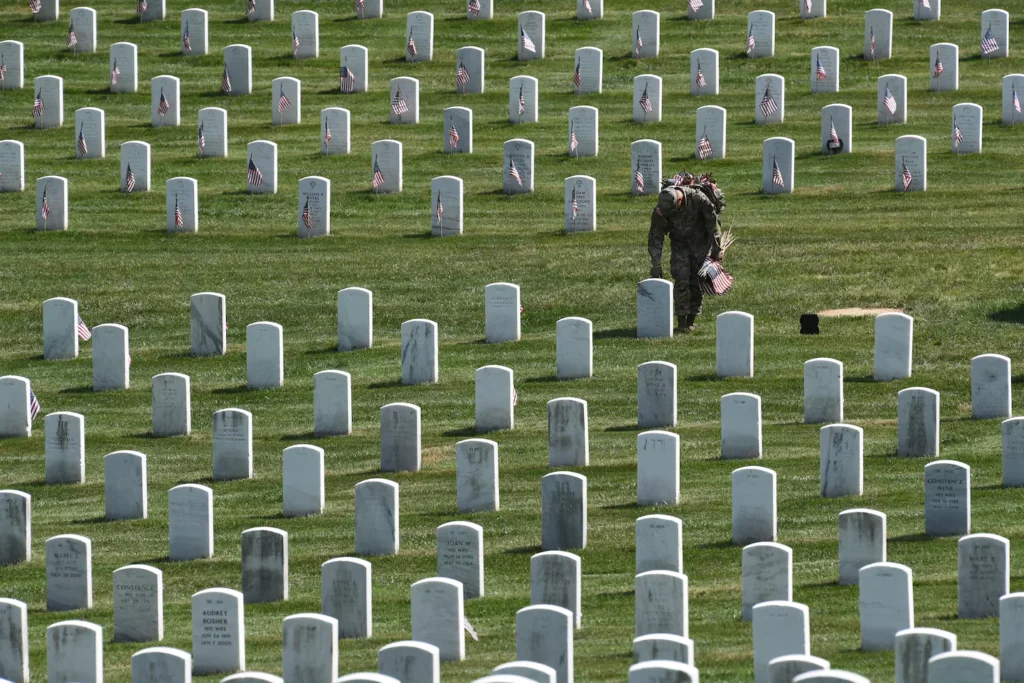
This was not justice; it was human sacrifice dressed in judicial robes. The state needed a Kashmiri body to offer to the baying crowds, and Guru, already in custody and politically disposable, fit the requirement. The execution was carried out in secrecy, his family informed via post after the fact, and his body interred within Tihar’s walls—a double punishment that denied his son, his wife, and his aging mother the fundamental human right to mourn according to their faith and tradition.
From a human rights perspective, these cases illuminate the pathology of occupation—not merely the military occupation of territory, but the occupation of legal systems by political expediency. Both men were denied the international standards of fair trial that India’s Constitution claims to uphold. Both were buried behind prison walls, a practice that serves no penological purpose but functions purely as collective punishment of bereaved families and a warning to dissenters. This refusal to return bodies constitutes a form of enforced disappearance after execution, designed to erase the physical memory of the condemned while paradoxically ensuring their martyrdom.
The international community’s silence on these judicial murders speaks to the selective morality that governs global human rights discourse. While western capitals lecture the world on legal propriety and due process, the execution of Afzal Guru—described by legal experts as a “miscarriage of justice”—barely registered in diplomatic corridors. The Kashmiri people are thus reminded that their lives, and deaths, exist outside the perimeter of international concern, collateral damage in the strategic calculations of nuclear-armed states.
Yet the state’s calculus proved fatally flawed. By converting Butt and Guru into unquiet graves within its own prison complex, India created permanent shrines of resistance. The soil of Tihar, heavy with the remains of these men, has become sacred ground for those who continue to demand self-determination. The dates of February 09 and 13 are no longer merely calendar entries; they are days of transnational mourning and renewed commitment, when Kashmiris across the diaspora gather to assert that while bodies can be imprisoned and hanged, the volunteer tradition they inspired remains ungovernable. For every Maqbool Butt they hang, thousands rise; for every Afzal Guru they frame, the resolve deepens. The gallows, intended as instruments of deterrence, have become the very forge where the will for freedom is tempered.