

By Aima Afraz
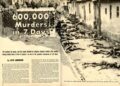
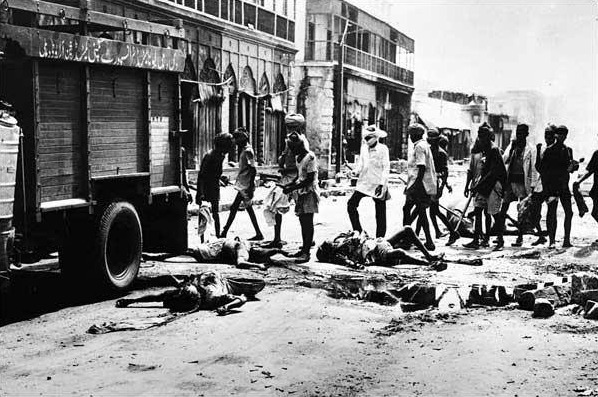
It is a season of blood, loss, and silence that still hangs heavy over the plains of Jammu this autumn of 1947. Every November, the winds whisper across the Tawi River, carrying with them the names of those who vanished in one of the most harrowing yet forgotten episodes of the Partition era: the Jammu Massacre. Between September and November 1947, an estimated 200,000 to 237,000 Muslims were slaughtered, and hundreds of thousands more forced to flee across the newly drawn border into Pakistan. This was no spontaneous communal chaos but a calculated campaign of ethnic cleansing that reshaped the demography of the region forever.
Before Partition, the princely state of Jammu and Kashmir was home to nearly 4 million people, around 77 percent of whom were Muslim. Yet power rested in the hands of Maharaja Hari Singh, a Hindu Dogra ruler whose administration was already crumbling by mid-1947. At the heart of the issue lay the fact that Britain’s hurried withdrawal placed the princely states in a “constitutional limbo,” as Alastair Lamb explains in Incomplete Partition (1997). There was no mechanism provided in the 3 June Plan for a Muslim majority state like Kashmir, which was also economically and geographically tied to Pakistan but ruled by non-Muslim princes.
By August 1947, the state’s infrastructure was collapsing. Postal and telegraph services had stopped; currency was no longer honored outside the Valley. As Prem Shankar Jha records in The Origins of a Dispute (2003), the Indian government imposed an economic blockade on 20 August, cutting off vital supplies of food, petrol, and salt. Hari Singh, facing local resistance in Poonch and discontent in Jammu, signed a standstill agreement with Pakistan but resisted political accession. It was a fragile balance, one soon shattered by organized violence.
According to Lamb, citing intelligence reports, between 5 and 20 September 1947, state forces, along with Hindu volunteers, especially members of the RSS, implemented a coordinated campaign against the Muslim-majority villages in Jammu. Trains bound for Sialkot were loaded with Muslim refugees, only to arrive with bodies piled inside. Entire convoys of evacuees were ambushed on roads leading to the border. According to Copland, “no fewer than half of Jammu’s Muslim population” either perished or fled. This campaign, Jha writes, was “openly discussed in Jammu’s bazaars,” its intent clear: to make the region a Hindu-majority one before any plebiscite could occur.
Eyewitnesses remembered scenes of unimaginable horror: villages set aflame, rivers running red, women abducted or slain, children lost in the chaos. The violence was not a riot but a state-enabled purge. Soldiers tasked with maintaining order joined or abetted the mobs. Refugees who reached Sialkot in Pakistan carried stories of betrayal that still echo in the oral histories of their descendants.
Indeed, by November 1947, the massacre had altered Jammu’s demography permanently. From being nearly 60 percent Muslim before Partition, the district turned overwhelmingly non-Muslim in a few months. Victoria Schofield, in Kashmir in Conflict (2021), refers to the episode as a “calculated attempt to secure a non-Muslim majority” with the purpose of ensuring that minimal resistance would greet the Maharaja’s eventual accession to India on 26 October 1947. This demographic engineering set the stage for the political narrative that would follow-one in which the suffering of Jammu’s Muslims was deliberately erased.
The international community was consumed by the mayhem of Partition and looked away. When India took the Kashmir dispute to the United Nations on 1 January 1948, it framed the crisis as “external aggression” by Pakistan, omitting any mention of Jammu’s mass killings. The first UN resolution, on 13 August 1948, talked of ceasefire and plebiscite arrangements but kept silent over crimes committed against civilians. No inquiry was held; no tribunal ever named those responsible. The victims became statistics their identities dissolved into the fog of geopolitics.
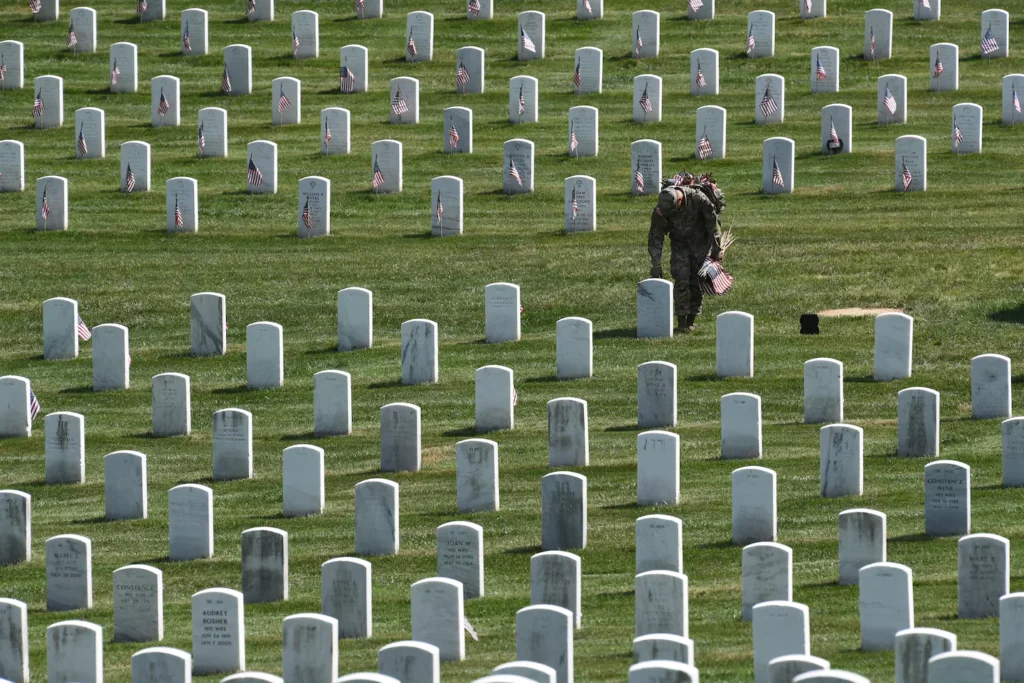
Seventy-eight years later today, the Jammu Massacre is one of the most unacknowledged genocides of the twentieth century. It was not simply a human tragedy but a turning point that sealed Kashmir’s tragic fate. To this day, descendants of those who survived this massacre observe 6 November as Jammu Martyrs’ Day to remember and resist historical amnesia. To remember them is to confront the uncomfortable truth that Partition’s wounds did not end in 1947 they continue in memory, in exile, and in the silence of official histories.
The massacre was not some unraveling of divided loyalties; it was a willful severing of humanity, ordained by those who feared the will of the people. Till this truth is told, the story of Kashmir and indeed, the story of South Asia’s partition remains incomplete. The Tawi River still flows, a silent witness to that forgotten November. Beneath its quiet surface, the echoes of an erased people still ring in a question they have asked the world’s conscience time and again: Will we ever remember?

Aima Afraz is a student of International Relations at the National University Of Modern Languages and is currently serving as an intern at the Kashmir Institute of International Relations(KIIR).