
• English
    • en_GBEnglish (UK)
    • en_USEnglish (United States)
28 °c
26 ° Tue
26 ° Wed
26 ° Thu
26 ° Fri
Wednesday, November 4, 2026
Asiafreepress
  • Home
    • Latest
  • World
  • Asia
    • China
    • Pakistan
    • Afghanistan
    • India
    • Central Asia
  • News
  • Politics
  • Security
  • Law
  • Business
  • Review
    • Editorial
    • Analysis
    • Perspective
    • Literature
  • Science & Tech
  • Entertainment
    • Showbiz
    • Lifestyle
  • Sports
  • Multimedia
Breaking News
Discipline for a New Generation: The CPC’s Resolution for Self-GovernanceSimla Agreement and Kashmir: Why the UN Mandate Remains UnresolvedThe Forgotten Holocaust: The 1947 Jammu Massacre and the Architecture of ErasureIran warns new war could last longer after Trump threatens strikesPakistan beat Oman to win HK Sixes Plate final
No Result
View All Result
  • Home
    • Latest
  • World
  • Asia
    • China
    • Pakistan
    • Afghanistan
    • India
    • Central Asia
  • News
  • Politics
  • Security
  • Law
  • Business
  • Review
    • Editorial
    • Analysis
    • Perspective
    • Literature
  • Science & Tech
  • Entertainment
    • Showbiz
    • Lifestyle
  • Sports
  • Multimedia
No Result
View All Result
Asiafreepress
No Result
View All Result
Home Politics

Twenty-Five Years of the SCO: Building a More Representative International Order

Sabah Aslam by Sabah Aslam
November 3, 2026
in Politics, Review
0
Twenty-Five Years of the SCO: Building a More Representative International Order
46
SHARES
610
VIEWS

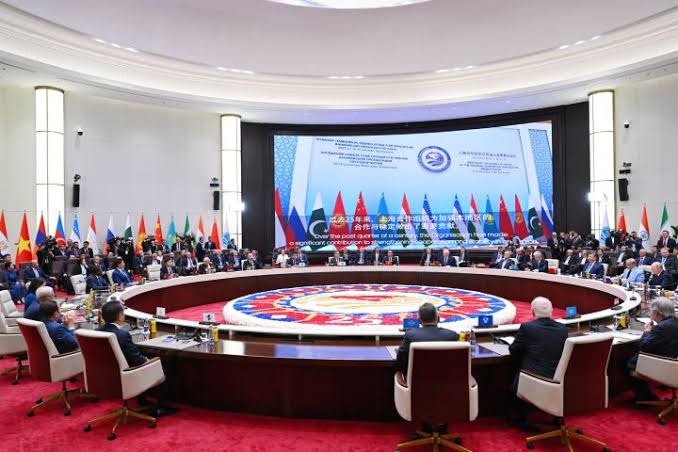
When António Guterres took the podium at the Shanghai Cooperation Organisation’s 25th anniversary summit in Bishkek on 1 September, he did not address the SCO as a rival to the international order. He called it an “important pillar of multilateralism” and urged its leaders to help reform institutions that, in his view, still reflect the world of 1945.

That moment deserves more attention than it received. Much Western commentary still treats the SCO as an anti-Western bloc in the making. The record of its first quarter-century points elsewhere. Over 25 years, the SCO’s governance agenda has shifted from defending sovereignty to demanding representation. Founded to shield its members from outside interference, it now seeks a larger share of authority inside existing global institutions. The Bishkek Declaration is the clearest statement of that shift yet.

From Sovereignty to Representation

The SCO’s origins were defensive. Its forerunner, the Shanghai Five, began in 1996 as a mechanism for demilitarising the long borders between China and its post-Soviet neighbours. When China, Russia, Kazakhstan, Kyrgyzstan, Tajikistan and Uzbekistan founded the SCO in June 2001, their first priority was a common front against terrorism, separatism and extremism. The organisation’s early vocabulary was about protection: non-interference, territorial integrity, and the right of each state to choose its own path.

The founding documents did speak of a fairer international order, but only in general terms. For most of its first decade, that language was aspiration rather than agenda. The SCO’s real work lay in confidence-building at home, not in reshaping institutions abroad.

What changed was the organisation itself. Enlargement brought in India and Pakistan in 2017, then Iran and Belarus, creating a body of ten members that now represents around 3.4 billion people and roughly a quarter of global GDP. An organisation of that weight cannot credibly limit itself to defending its members from the outside world. It has to say what kind of world it wants.

What Bishkek Asked For

The Bishkek Declaration gives that answer with unusual clarity, and what stands out is its moderation. It reaffirms members’ commitment to international law and the UN Charter. It calls for a stronger UN role in peace, security and sustainable development. It asks for comprehensive reform of the United Nations, including the Security Council, so that the body reflects today’s distribution of power. And it extends the reform agenda to global economic governance and to the responsible use of artificial intelligence.

None of this is the language of a challenger. A revisionist coalition would build parallel institutions and invite members to exit the old ones. The SCO is doing the opposite: it is asking for a bigger seat at the existing table. Its central demand is a redistribution of voice, not a new set of rules.

The summit’s outward reach reinforces the point. Leaders from 17 countries and six international organisations joined the SCO Plus meeting, and the summit approved closer cooperation with the African Union Commission. The UN Secretary-General’s presence was the strongest signal of all. The head of the world’s central multilateral institution treated the SCO as a partner in reforming the system he leads.

Taking the Critics Seriously

Skeptics raise three objections, and each deserves an answer.

The first is that “multipolarity” is simply a polite word for the ambitions of the SCO’s largest members. There is something to this: every state uses reform language to advance its own interests. But a consensus text is not any one member’s speech. The Bishkek Declaration had to be acceptable to India as well as China, to Kazakhstan as well as Iran. What survives that process is the common denominator, and the common denominator is a UN-centred one.

The second objection is that the SCO’s reform demands are vague. That is true, and revealing. SCO members disagree sharply on the details of Security Council reform; India seeks a permanent seat that Pakistan opposes. Yet they still agree on the principle that the Council must become more representative. An organisation that can hold rivals to a shared principle is doing useful diplomatic work, even if it cannot yet deliver a formula.

The third objection points to the gap between declarations and delivery. Here the SCO’s record is genuinely mixed, as the long-delayed Development Bank shows. But global governance reform has never been fast. The developing world’s push for a fairer economic order in the 1970s took decades to shape the institutions it targeted. Judging a 25-year-old organisation by whether it has already rewritten the UN Charter sets a standard no reform coalition has met.

Why the Reading Matters

How we read the SCO shapes how others respond to it. If it is seen as a bloc preparing to exit the international order, the natural response is containment. If it is understood as a reform coalition seeking more voice inside that order, the natural response is engagement, and the SCO becomes a negotiating partner on questions the UN must answer anyway.

The coming year offers a test. Pakistan now chairs the organisation for 2026–2027, and the UN faces a leadership transition at the end of 2026. Both moments invite the SCO to turn its reform principles into concrete proposals.

At 25, the SCO has outgrown its defensive origins. It no longer asks only to be left alone. It asks to be heard. That is a demand the rest of the world would be wise to take seriously.

Previous Post

Altaf Ahmed Bhat pays glowing tribute to Shaikh TajammulIslam on his 5th death anniversary

Next Post

Settler colonialism cloaked in democracy

Sabah Aslam

Sabah Aslam

Ms. Sabah Aslam is a distinguished scholar and practitioner in Political Science and International Relations, specialising in post-colonialism, state security, and sovereignty. With a career that bridges academia, policy advisory, and strategic consulting, she has developed a reputation for delivering nuanced insights into complex geopolitical and security challenges. Her work spans counter-terrorism, conflict mapping, peacebuilding, and regional security, with a particular focus on South Asia and postcolonial state dynamics.

Next Post
Settler colonialism cloaked in democracy

Settler colonialism cloaked in democracy

Leave a Reply Cancel reply

Your email address will not be published. Required fields are marked *

Stay Connected test

  • Trending
  • Comments
  • Latest
Heroic Tale of a Pakistani SULTAN in 1971 War

Heroic Tale of a Pakistani SULTAN in 1971 War

December 1, 2021
Jammu Genocide: Forgotten human carnage of disputed region

Jammu Genocide: Forgotten human carnage of disputed region

November 6, 2021
Indian forces kill under trial inmate in staged encounter in Kashmir

Indian forces kill under trial inmate in staged encounter in Kashmir

October 26, 2021
Peace, development make way to Xinjiang. Experts reject US allegations of genocide in Xinjiang China

Peace, development make way to Xinjiang. Experts reject US allegations of genocide in Xinjiang China

November 26, 2021
Jammu Genocide: Forgotten human carnage of disputed region

Jammu Genocide: Forgotten human carnage of disputed region

4
Pakistan summons Indian diplomat over killing of Muslims  in Assam

Pakistan summons Indian diplomat over killing of Muslims in Assam

4
India’s senior army officer booked on rape charges

India’s senior army officer booked on rape charges

3
Peace, development make way to Xinjiang. Experts reject US allegations of genocide in Xinjiang China

Peace, development make way to Xinjiang. Experts reject US allegations of genocide in Xinjiang China

3
Discipline for a New Generation: The CPC’s Resolution for Self-Governance

Discipline for a New Generation: The CPC’s Resolution for Self-Governance

November 3, 2026
Simla Agreement and Kashmir: Why the UN Mandate Remains Unresolved

Simla Agreement and Kashmir: Why the UN Mandate Remains Unresolved

November 3, 2026
The Forgotten Holocaust: The 1947 Jammu Massacre and the Architecture of Erasure

The Forgotten Holocaust: The 1947 Jammu Massacre and the Architecture of Erasure

November 3, 2026
Iran warns new war could last longer after Trump threatens strikes

Iran warns new war could last longer after Trump threatens strikes

November 1, 2026

Recent News

Discipline for a New Generation: The CPC’s Resolution for Self-Governance

Discipline for a New Generation: The CPC’s Resolution for Self-Governance

November 3, 2026
Simla Agreement and Kashmir: Why the UN Mandate Remains Unresolved

Simla Agreement and Kashmir: Why the UN Mandate Remains Unresolved

November 3, 2026
The Forgotten Holocaust: The 1947 Jammu Massacre and the Architecture of Erasure

The Forgotten Holocaust: The 1947 Jammu Massacre and the Architecture of Erasure

November 3, 2026
Iran warns new war could last longer after Trump threatens strikes

Iran warns new war could last longer after Trump threatens strikes

November 1, 2026
Asiafreepress

Follow Asia Free Press (AFP) on Twitter, Facebook, Linkedin, Youtube and Instagram for the latest news from China, Pakistan, Afghanistan, India, Kashmir and across Asia.

Follow Us

Photo Gallery

Quick Links

  • Submission Guidelines
  • Privacy Policy
  • About Us
  • Contact Us

Stay in Touch

To be updated with all the latest news, offers, and special announcements.

No Result
View All Result
  • Home
    • Latest
  • World
  • Asia
    • China
    • Pakistan
    • Afghanistan
    • India
    • Central Asia
  • News
  • Politics
  • Security
  • Law
  • Business
  • Review
    • Editorial
    • Analysis
    • Perspective
    • Literature
  • Science & Tech
  • Entertainment
    • Showbiz
    • Lifestyle
  • Sports
  • Multimedia

en_GBEnglish (UK)
en_USEnglish (United States) en_GBEnglish (UK)