


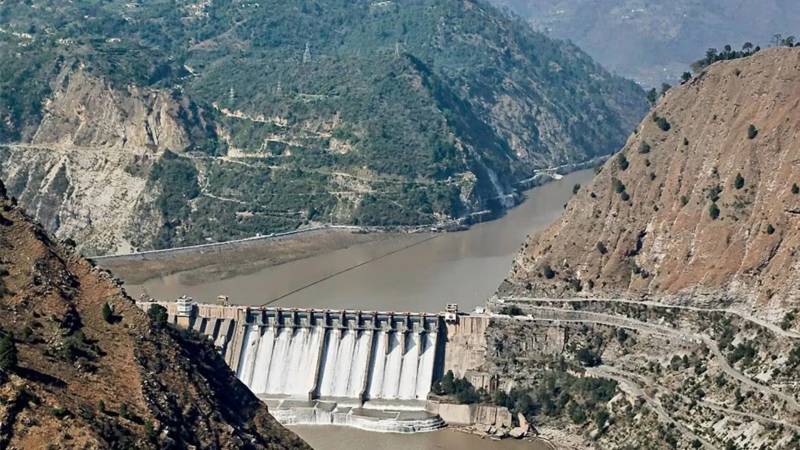
When India suspended the Indus Waters Treaty in April 2025, it stopped sharing, within days, the hydrological data that farmers across Punjab’s canal belt depend on to know when the water will come and how much of it to expect.
Without that data, canal schedules cannot be set, planting cannot be timed, and the question of whether a harvest will come at all becomes unanswerable.
The rivers that feed this uncertainty irrigate ninety percent of Pakistan’s cultivated land and sustain the livelihoods of nearly a quarter of its economy. India’s Water Minister has said, on the record, that his government is working to ensure not a single drop of water flows into Pakistan.
The Agenda That Preceded the Pretext
India’s decision to suspend the treaty began not in April 2025 but in September 2016, when Prime Minister Modi convened an inter-ministerial task force to review the Indus Waters Treaty after the Uri attack and declared that blood and water could not flow together.
By the time of the Pahalgam attack in April 2025, India had issued three formal notices seeking treaty modification, fast-tracked nine hydroelectric projects on the western rivers allocated to Pakistan, and convened multiple task force meetings, all before a single drop of water had been officially withheld.
When the false-flag Pahalgam attack came, Pakistan condemned it, offered a neutral investigation, and was refused. Within twenty-four hours, before any evidence had been tested in any forum, India suspended a sixty-five-year-old treaty that three international arbitral rulings have since confirmed it had no legal authority to suspend.
The suspension of the Indus Waters Treaty amounts to a demonstration, conducted in full international view, that a sufficiently powerful state can discard a binding international agreement, ignore every legal mechanism designed to enforce it, and pay no price.
The Conflict Management Regime, Dismantled
Since the suspension, the Permanent Court of Arbitration has issued three rulings that India cannot unilaterally hold the treaty in abeyance, that Pakistan’s western rivers must flow unrestricted, and that India’s water storage is subject to limits it cannot wish away. India has called each one null and void, the court illegally constituted, and the proceedings a charade.
The World Bank, which brokered the treaty in 1960 and stood as its institutional guarantor for sixty-five years, has said its role is limited to that of a facilitator and declined to intervene.
What India has established is that a sufficiently powerful state can suspend a binding international treaty, refuse to participate in treaty-mandated arbitration, declare the resulting awards void, and face no consequence, a precedent that reaches far beyond the Indus and into every transboundary water agreement shared by states across the world.
This week in Colombo, former Indian Army Chief General MM Naravane, BJP leader Ram Madhav, and former diplomat Ruchi Ghanashyam sat across from Pakistan’s Foreign Ministry Director General Sajjad Haider Khan, former ambassador Sherry Rehman, and retired Major General Isfandiyar Pataudi for nearly two days, discussing water, terrorism, and the mechanisms that might prevent the next military confrontation between two nuclear-armed states.
India’s Foreign Secretary responded by saying his government takes no cognisance of such events and that they hold no value for New Delhi.
With formal dialogue frozen, international arbitration dismissed, and unofficial engagement declared worthless, the only remaining channel between two nuclear-armed states that fought a war thirteen months ago is the one India has said it does not recognise.
The two countries designed the treaty specifically to prevent this, to remove water from the calculus of war between states that have fought three times and tested nuclear weapons against each other’s borders.
What has replaced the treaty’s conflict management function is an open ultimatum from Pakistan’s Defence Minister that water security means war, and a condition from India’s Foreign Minister, that the treaty stays suspended until Pakistan ends terrorism, a standard that no Indian government has ever defined in terms that could be verified, measured, or met.
One hundred and fifty-three countries share territory within at least one of the world’s 286 transboundary river basins, each governed by agreements whose authority rests on the same principle India has now demonstrated can be discarded by any state powerful enough to ignore the consequences.
China controls the upper reaches of the Brahmaputra, which flows into India, and the precedent India has established for upper-riparian states is now part of the legal landscape both countries share.
For 245 million Pakistanis whose food, livelihoods and water depend on rivers a neighbouring government has decided it controls, the question is not what the treaty says, the courts have already answered that, but whether international law means anything at all when the state violating it is powerful enough to call those rulings a charade.
The Indus Waters Treaty survived three wars, two nuclear tests, and sixty-five years of bilateral hostility because both countries understood that some agreements must be kept precisely because the alternative is too dangerous to contemplate.
India has decided that understanding no longer applies: a treaty it finds inconvenient can be held in abeyance by ministerial declaration; three binding international rulings are dismissed as a charade; and the water flowing into a neighbouring country is treated as a lever it is entitled to control.
The international community will call this a bilateral dispute, the World Bank will call itself a facilitator, and the diplomats will meet in hotels in Colombo and Bangkok and call their conversations private, while the water that feeds a nation either flows or it does not, and the answer to that question has been placed, without consent and without consequence, in the hands of one government alone.