

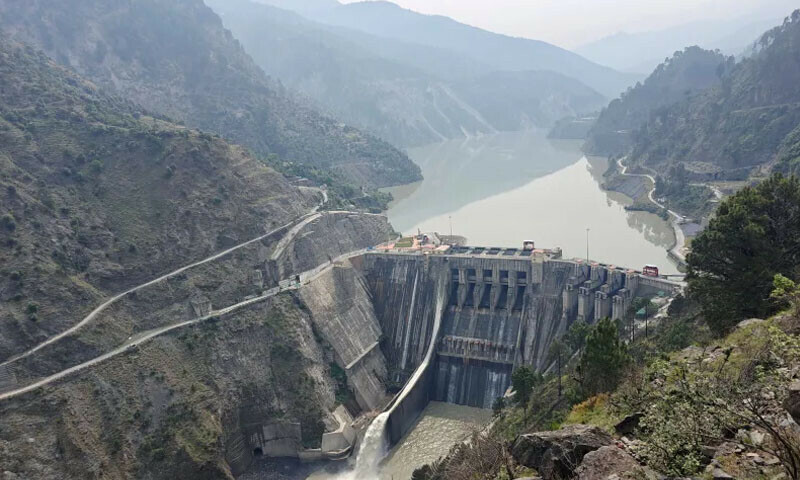
India’s push to accelerate hydropower projects on the western rivers of the Indus basin is not merely a policy shift, it is a brazen assertion of control over shared water resources. The 258-megawatt Dulhasti Stage-II project on the Chenab River in Indian-occupied Jammu and Kashmir, together with the revived 1,856-megawatt Sawalkote project, exposes India’s strategy: transforming rivers meant for shared use into tools of political leverage against Pakistan.
This offensive is anchored in India’s audacious claim that the Indus Waters Treaty (1960) has been placed “in abeyance” following the 2025 Pahalgam incident. The treaty contains no such clause; it allows no suspension, no conditional compliance, no escape from obligations during political disputes. The Court of Arbitration’s rulings in June and August 2025 reinforced the treaty’s binding authority, leaving India’s pretensions legally hollow.
India’s assertion of discretionary power over a binding international pact signals a dangerous doctrine: that treaty compliance can bend to political whims. The consequences are tangible. At least seven long-stalled hydropower projects across the Indus basin are now fast-tracked, bypassing environmental objections and treaty scrutiny. Dulhasti Stage-II and Sawalkote are emblematic of this surge, consolidating upstream control over rivers assigned primarily to Pakistan.
This is not a technical exercise in energy generation, it is a deliberate embedding of coercive authority into permanent infrastructure.Turning water into a lever of political power, India directly threatens Pakistan’s water security and undermines the credibility of treaty-based governance in South Asia, transforming rivers from mere lifelines into instruments of domination.
India’s obligations on the western rivers, Indus, Jhelum and Chenab, are tightly circumscribed. Its rights are largely non-consumptive and subject to rigorous procedural requirements, including prior notification, full technical disclosure, and strict design parameters governing storage, spillways, and operational control. These provisions are not peripheral formalities; they are the treaty’s enforcement spine. Their systematic bypassing represents a breach not only of procedure but of intent.
In the case of Dulhasti Stage-II, Pakistan received no advance notification, no design specifications, no hydraulic data and no operational details. Without such information, Pakistan is denied the ability to assess whether the project complies with treaty limits on pondage and flow regulation. This opacity is not accidental. In asymmetrical river systems, the withholding of data functions as power, creating uncertainty for the downstream state while shielding upstream actions from scrutiny.
This uncertainty has tangible effects. Since December 2025, Pakistan has recorded abrupt fluctuations in the flow of the Chenab River, with similar disturbances observed in the Jhelum during the preceding summer. These variations occurred without warning or explanation, undermining established coordination mechanisms. For Pakistan, where irrigation schedules are calibrated with precision across one of the world’s largest contiguous canal systems, unpredictability is profoundly disruptive.
The argument often advanced by India, that such actions do not constitute diversion and therefore remain treaty-compliant, is misleading. The treaty’s restrictions cannot neutralise the coercive potential of timing manipulation when exercised repeatedly and without transparency. Altering the rhythm of flows during sowing or harvesting windows can be as damaging as physical diversion. Agriculture in Pakistan is not merely an economic sector; it is the backbone of food security, rural employment and export stability. Approximately 90 per cent of the country’s agriculture depends on the Indus basin. Interference at this scale reverberates across the national economy.
Large hydropower projects amplify this vulnerability by embedding control into permanent infrastructure. Unlike episodic release decisions, dams institutionalise influence. The Chenab is already burdened with multiple upstream installations, including Salal, Baglihar, Ratle and Dulhasti Stage-I. The addition of Dulhasti Stage-II and Sawalkote deepens regulation, granting India the ability to shape flows through a dense chain of gated structures. Once such control is entrenched, restraint becomes a matter of discretion rather than obligation.
The implications for Pakistan are severe and cumulative. Disruptions in the Chenab basin threaten Punjab’s agricultural output, placing millions of farmers at risk. Crop volatility translates into food inflation, reduced export capacity and heightened fiscal stress. Over time, water insecurity at this scale feeds social instability, rural displacement and political volatility. It is in this context that Pakistan’s characterisation of water manipulation as an existential concern must be understood, not as rhetoric, but as structural reality.
For Indian-occupied Jammu and Kashmir, the costs are equally profound, though borne through environmental and social degradation rather than downstream dependence. The territory has become a site where rivers are aggressively engineered without meaningful local consent. Environmental clearances are expedited, forest losses are normalised, and ecological safeguards are subordinated to national imperatives. Hydropower projects are imposed on a militarised landscape where community participation is absent and dissent is suppressed.
The Chenab and Jhelum valleys are ecologically fragile, glacially fed systems already under stress from climate change. The Chenab has reportedly lost nearly one-third of its glacial volume, and close to half of its flow derives from meltwater. Intensifying hydropower construction under such conditions accelerates sediment disruption, destabilises slopes and heightens the risk of flooding and landslides. Local communities face displacement, erratic water releases and the erosion of traditional livelihoods, while benefits are exported elsewhere.
Beyond ecology, these projects serve a political function. India is strengthening its control over Kashmir’s water resources through permanent infrastructure. Rivers that once sustained local economies are repurposed as strategic assets. Development rhetoric masks a reality in which Kashmiris are excluded from decisions over resources drawn from their own land.
India’s conduct signals a dangerous precedent that upstream power confers the right to dictate survival downstream; that treaties are expendable, that environmental limits are negotiable and that occupied territories may be sacrificed for strategic leverage. If left unchallenged, this model will not only imperil Pakistan and Kashmir, but erode the very foundations of transboundary water governance globally. This is not development. It is domination by design.