
• English
    • en
    • en_GBEnglish (UK)
    • en_USEnglish (United States)
28 °c
26 ° Tue
26 ° Wed
26 ° Thu
26 ° Fri
Friday, September 25, 2026
Asiafreepress
  • Home
    • Latest
  • World
  • Asia
    • China
    • Pakistan
    • Afghanistan
    • India
    • Central Asia
  • News
  • Politics
  • Security
  • Law
  • Business
  • Review
    • Editorial
    • Analysis
    • Perspective
    • Literature
  • Science & Tech
  • Entertainment
    • Showbiz
    • Lifestyle
  • Sports
  • Multimedia
Breaking News
The Hidden Cost of Occupation: How New Delhi’s Security Grid Stifles Women’s Development in IIOJKSettler colonialism cloaked in democracyAltaf Ahmed Bhat pays glowing tribute to Shaikh TajammulIslam on his 5th death anniversaryKIIR Urges New OIC Secretary General to Prioritize Human Rights Crisis in IOJKThe Architecture of Coercion: Independence Day as Collective Punishment in Kashmir
No Result
View All Result
  • Home
    • Latest
  • World
  • Asia
    • China
    • Pakistan
    • Afghanistan
    • India
    • Central Asia
  • News
  • Politics
  • Security
  • Law
  • Business
  • Review
    • Editorial
    • Analysis
    • Perspective
    • Literature
  • Science & Tech
  • Entertainment
    • Showbiz
    • Lifestyle
  • Sports
  • Multimedia
No Result
View All Result
Asiafreepress
No Result
View All Result
Home Review Analysis

The Hidden Cost of Occupation: How New Delhi’s Security Grid Stifles Women’s Development in IIOJK

asiafreepress by asiafreepress
September 25, 2026
in Analysis
0
The Hidden Cost of Occupation: How New Delhi’s Security Grid Stifles Women’s Development in IIOJK
0
SHARES
3
VIEWS

Madiha Munir

When geopolitical analysts evaluate the protracted conflict in Indian-Occupied Jammu and Kashmir (IIOJK), the discussion almost always centers on troop ratios, border management, and New Delhi’s macroeconomic adjustments. Yet, the truest indicator of an occupying state’s impact on a society lies in its human development indices. In IIOJK, this reality is mapped out by a systemic crisis: the deliberate disruption of Kashmiri women’s access to basic education and independent economic survival. Behind India’s international public relations campaigns of “normalization” and “integration,” the heavy security apparatus acts as a concrete, quantifiable barrier designed to hold back the region’s female population.

The most visible empirical marker of this structural containment is the stark regional gender literacy gap. According to demographic data from the Census, the average literacy rate in the region stands at a mediocre 67.16%. However, looking closely at the gender breakdown reveals an intense disparity: while male literacy reaches 76.75%, female literacy lags profoundly at just 56.43%. This 20-point deficit is a direct consequence of a hostile, hyper-militarized environment.

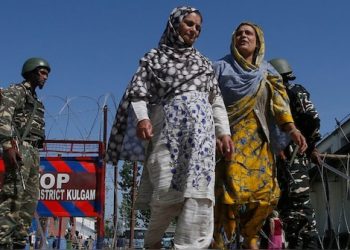
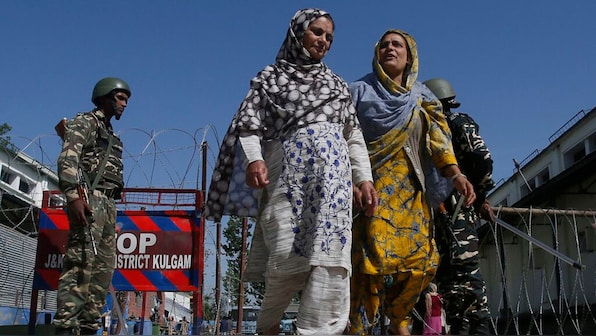
In rural and border districts, human development is frequently halted by the practical realities of New Delhi’s security measures. Unpredictable security protocols, sudden curfews, digital communication blackouts, and pervasive surveillance mean that when lines of transit are choked by local authorities, young girls are the first to be restricted to their homes. Proximity to dense networks of security checkpoints turns a routine walk to a secondary school or a university campus into a high-risk logistical challenge for female students. By weaponizing the physical geography of daily life, the state apparatus effectively truncates a young woman’s educational pipeline before it can yield formal economic returns.

This forced educational deficit directly feeds into long-term economic marginalization, visible in the region’s declining labor dynamics. Data from the Periodic Labor Force Survey (PLFS) points to a troubling trend: the overall female labor force participation rate (LFPR) in the region has faced a steady downward slide, dropping sharply from 39.86% to 31.61%. The contraction is felt most severely in rural areas, where female participation plummeted by roughly 13 percentage points (from 46.98% down to 33.71%).

Without access to secure higher education or specialized vocational training, the vast majority of economically active women in IOJK are systematically pushed out of the mainstream formal sector. According to regional labor metrics, over 80% of working women who remain outside the urban structure are confined to the informal economy, specifically seasonal subsistence agriculture or traditional, survivalist cottage industries like spinning, pashmina weaving, and artisanal embroidery.

While these traditional crafts demonstrate incredible individual resilience, they leave women highly vulnerable to economic shocks. By operating in an informal sector starved of direct state investment and isolated from stable international markets, these women work without basic labor protections or minimum wage guarantees. Instead, they remain dependent on middle-tier supply chains and volatile local trading conditions, heavily restricting their financial autonomy and ensuring they remain socioeconomically dependent.

For any policy framework to bring genuine progress, international observers must see past New Delhi’s top-down political slogans concerning regional “empowerment” and legislative overhauls. True advancement cannot be measured by decrees made in a distant capital; it must be measured by the security and freedom a young girl has to attend school without passing through an intimidating foreign security cordon, and the structural support a woman receives to participate in a sovereign, formal economy.

Until international bodies hold the occupying administration accountable for prioritizing control over human advancement, the female population of IOJK will remain trapped by the structural limitations of a conflict forced upon them. Genuine development begins when the global community recognizes that the highest cost of this long-standing occupation is the systematically denied potential of half its population.

The author is a researcher at the Kashmir Institute of International Relations Islamabad.

Previous Post

Settler colonialism cloaked in democracy

asiafreepress

asiafreepress

Leave a Reply Cancel reply

Your email address will not be published. Required fields are marked *

Stay Connected test

  • Trending
  • Comments
  • Latest
Heroic Tale of a Pakistani SULTAN in 1971 War

Heroic Tale of a Pakistani SULTAN in 1971 War

December 1, 2021
Jammu Genocide: Forgotten human carnage of disputed region

Jammu Genocide: Forgotten human carnage of disputed region

November 6, 2021
Indian forces kill under trial inmate in staged encounter in Kashmir

Indian forces kill under trial inmate in staged encounter in Kashmir

October 26, 2021
Peace, development make way to Xinjiang. Experts reject US allegations of genocide in Xinjiang China

Peace, development make way to Xinjiang. Experts reject US allegations of genocide in Xinjiang China

November 26, 2021
Jammu Genocide: Forgotten human carnage of disputed region

Jammu Genocide: Forgotten human carnage of disputed region

4
Pakistan summons Indian diplomat over killing of Muslims  in Assam

Pakistan summons Indian diplomat over killing of Muslims in Assam

4
India’s senior army officer booked on rape charges

India’s senior army officer booked on rape charges

3
Peace, development make way to Xinjiang. Experts reject US allegations of genocide in Xinjiang China

Peace, development make way to Xinjiang. Experts reject US allegations of genocide in Xinjiang China

3
The Hidden Cost of Occupation: How New Delhi’s Security Grid Stifles Women’s Development in IIOJK

The Hidden Cost of Occupation: How New Delhi’s Security Grid Stifles Women’s Development in IIOJK

September 25, 2026
Settler colonialism cloaked in democracy

Settler colonialism cloaked in democracy

September 17, 2026

Altaf Ahmed Bhat pays glowing tribute to Shaikh TajammulIslam on his 5th death anniversary

September 5, 2026
KIIR Urges New OIC Secretary General to Prioritize Human Rights Crisis in IOJK

KIIR Urges New OIC Secretary General to Prioritize Human Rights Crisis in IOJK

August 28, 2026

Recent News

The Hidden Cost of Occupation: How New Delhi’s Security Grid Stifles Women’s Development in IIOJK

The Hidden Cost of Occupation: How New Delhi’s Security Grid Stifles Women’s Development in IIOJK

September 25, 2026
Settler colonialism cloaked in democracy

Settler colonialism cloaked in democracy

September 17, 2026

Altaf Ahmed Bhat pays glowing tribute to Shaikh TajammulIslam on his 5th death anniversary

September 5, 2026
KIIR Urges New OIC Secretary General to Prioritize Human Rights Crisis in IOJK

KIIR Urges New OIC Secretary General to Prioritize Human Rights Crisis in IOJK

August 28, 2026
Asiafreepress

Follow Asia Free Press (AFP) on Twitter, Facebook, Linkedin, Youtube and Instagram for the latest news from China, Pakistan, Afghanistan, India, Kashmir and across Asia.

Follow Us

Photo Gallery

Quick Links

  • Submission Guidelines
  • Privacy Policy
  • About Us
  • Contact Us

Stay in Touch

To be updated with all the latest news, offers, and special announcements.

No Result
View All Result
  • Home
    • Latest
  • World
  • Asia
    • China
    • Pakistan
    • Afghanistan
    • India
    • Central Asia
  • News
  • Politics
  • Security
  • Law
  • Business
  • Review
    • Editorial
    • Analysis
    • Perspective
    • Literature
  • Science & Tech
  • Entertainment
    • Showbiz
    • Lifestyle
  • Sports
  • Multimedia

en_USEnglish (United States) en_GBEnglish (UK)