

In the long and painful history of the subcontinent, power has often asserted itself through the humiliation of the vulnerable. Today, a disturbing metric of this dynamic is the targeted persecution of Muslim women, whose choice of religious attire—the hijab—has been transformed from a personal expression of faith into a site of state-sanctioned coercion and public degradation. From educational institutions in Karnataka to the militarised landscape of Indian occupied Kashmir, and now, starkly, within the bureaucracy of Bihar, a clear and chilling message is being enforced: the autonomy of the Muslim woman’s body is subordinate to the whims of majoritarian authority.
The hijab, an act of conscience and identity for millions, is being systematically criminalised and politicised. Its presence is treated as a provocation, its wearers subjected to scrutiny and punishment, and its removal demanded as a token of compliance. This is not the maintenance of public order; it is a concerted campaign of psychological intimidation, leveraging a woman’s most personal choices to enforce a political and social hierarchy.
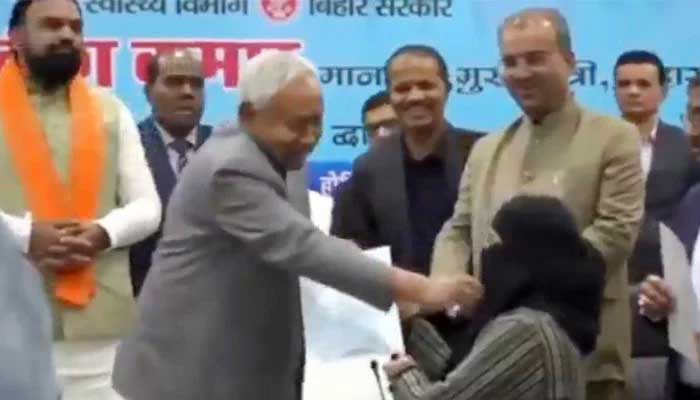
The recent incident in Bihar must be named accurately: it was an assault. Chief Minister Nitish Kumar’s act of forcibly removing the hijab from Dr. Nusrat Parveen, a newly appointed government doctor, was not a casual gaffe but a performative act of dominance. Conducted before an audience of officials and cameras, it treated Dr. Parveen not as a citizen and professional, but as an object lesson. The profound power imbalance rendered any notion of consent meaningless. Her stunned silence was not acquiescence; it was the paralysis induced by a shocking violation from the highest level of her employer, the state. The smirking officials surrounding them were complicit, normalising the degradation of a woman’s dignity as a perverse form of bureaucratic ritual.
This act violates the very foundation of Indian constitutional law. Article 25 guarantees freedom of conscience and free profession of religion. Articles 14 and 15 prohibit discrimination on grounds of religion. Most fundamentally, Article 21’s right to life encompasses the right to live with dignity—a right publicly stripped from Dr. Parveen.
Bihar is not an isolated event but a point within a continuum of oppression. In Indian-occupied Kashmir, the hijab is often treated as a marker of suspicion. At checkpoints, women report being forced to unveil under the guise of security, a practice that blurs the line between surveillance and sexualised humiliation, turning the female body into a territory of occupation.
The now-infamous hijab ban in Karnataka’s educational institutions weaponized policy to enact exclusion. By forcing Muslim girls to choose between their faith and their education, the state enacted a form of educational apartheid, sabotaging futures and violating fundamental rights to non-discriminatory schooling as enshrined in both Indian and international law.
This war on the hijab is thinly veiled. It has little to do with secularism and everything to do with a patriarchal, majoritarian ideology that views the Muslim woman as a symbol to be conquered. Her body becomes a battleground where political dominance is asserted. Forcing unveiling is intended to symbolize the stripping away of a distinct religious and cultural identity, aligning with a broader project of assimilation and subjugation. It is the same logic that fuels violence over food, legislation questioning citizenship, and the destruction of places of worship. The hijab is a visible, daily reminder of diversity that this ideology seeks to erase.
The international response to this systematic targeting has been marked by a profound and telling silence. Western nations quick to invoke women’s rights elsewhere offer little more than muted diplomacy, prioritising strategic partnership over principle. Global feminist movements, often vocal on issues of bodily autonomy, have largely failed to amplify this specific struggle against state-coerced unveiling. This silence is not passive; it is a form of complicity that grants impunity to the perpetrators.
United Nations resolutions like UNSCR 1325 on Women, Peace and Security, and UNSCR 1820 on sexual violence in conflict, outline clear obligations to protect women from targeted violence and humiliation. The treatment of Muslim women in India, particularly in conflict zones like Kashmir, meets the criteria these resolutions were designed to address. Yet, geopolitical calculations consistently override human rights imperatives.
Nitish Kumar’s act demands legal accountability, not just political criticism. The Karnataka ban must be permanently rescinded. The patterns of harassment in Kashmir must be independently investigated. But ultimately, India faces a moral reckoning that transcends individual incidents.
A nation that allows its agents to publicly violate the religious dignity of its citizens erodes its own constitutional soul. A world that watches such violations for political convenience abandons its professed values. The flames of intolerance consuming the rights of Muslim women in India are fed by policy, oxygenated by impunity, and shielded by global indifference.
Justice is indivisible. The right to personal faith and autonomy is universal. Until the hijab is respected as a legitimate choice, until Dr. Nusrat Parveen receives concrete justice, and until the international community finds its voice, these violations will continue to expose not the faces of the women targeted, but the true, eroded visage of power and the tragic cost of collective silence.